

Bag-On-Valve vs Traditional Aerosol Systems
What is the Difference between Traditional Aerosol and Bag-On-Valve?
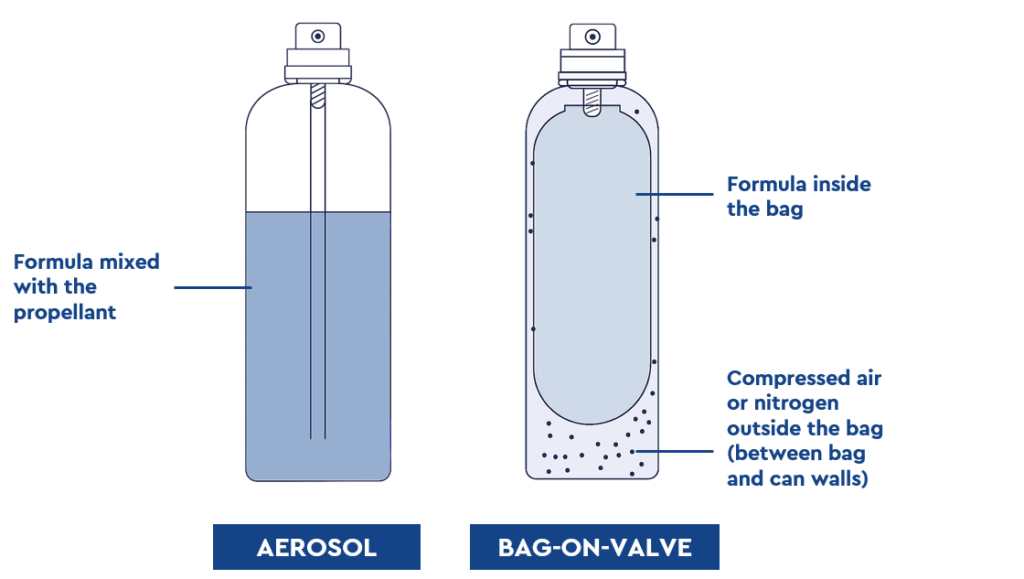
When comparing Bag-On-Valve aerosol systems with traditional aerosols, the key distinction lies in how the product and propellant are kept inside the can:
- Bag-On-Valve (BOV) system: the product is enclosed and protected inside a bag attached to the valve. Compressed air or nitrogen surrounds this bag and allows the formula to be dispensed without ever coming into contact with the eco-friendly propellant.
- Traditional aerosols: the product is mixed directly with the propellant (often chemical) inside the can.
Key Differences that Affect Performance and Sustainability
Product Purity and Stability
Bag-On-Valve aerosol systems offer a key advantage: they act as a true barrier packaging solution, keeping the formula completely separated from the propellant. This protective barrier helps reduce the risk of contamination and oxidation, preserving product integrity, stability, and quality over time. Unlike traditional aerosols, where the formula is mixed with the propellant, BOV systems ensure that consumers receive only the pure product (and not a blend of product and propellant). This results in higher product quality, greater safety, and better protection for sensitive formulations. Another significant benefit is that because the product remains in a protected environment, BOV formulations often require fewer or no preservatives. This allows for “cleaner” and natural formulations, which is a major advantage in today’s cosmetics, health and food markets where consumers are increasingly looking for purity and transparency.Dispensing Flexibility
With its bag attached to the valve and the propellant outside the bag, the design of a Bag-On-Valve system allows dispensing from any angle, providing better convenience and reducing product waste. Traditional aerosols typically require the can to be upright to work properly, which limits flexibility and can lead to uneven sprays. While there are special actuators that allow traditional aerosols to spray upside down, they still offer far less flexibility and cannot match the true 360° spraying performance of a BOV system, which delivers the same high-quality spray at any angle.Propellant Types
Bag-On-Valve aerosols use compressed air or nitrogen as propellants. These propellants are safe and environmentally friendly gases. Traditional aerosols often rely on chemical propellants like hydrocarbons or HFCs. While effective at generating spray pressure, these substances raise environmental and health concerns.Environmental Impact and Waste Reduction
Bag-On-Valve systems ensure nearly complete product evacuation and reduce environmental impact by using eco-friendly propellants such as compressed air or nitrogen. At Power Container Corporation, we designed an exclusive mono-material PET pouch for our BOV solution which represents a lower-impact alternative to the conventional multi-layer bag. This innovation is also fully compatible with PCR (post-consumer recycled) PET, enabling an even more sustainable packaging solution. Discover Power Pouch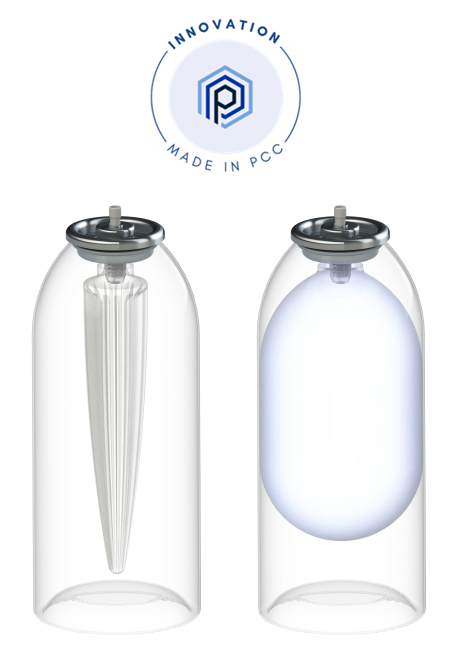

Why Choose Bag-On-Valve Aerosol Systems?
Bag-On-Valve aerosol systems provide important benefits for both brands and end users:
- Higher product purity: the formula remains completely separated from the propellant, making Bag-On-Valve systems ideal for products that require high-purity such as pharmaceuticals, cosmetics and food.
- Reliable 360° dispensing: Bag-On-Valve systems deliver a steady product flow at any angle, improving convenience and helping reduce product waste.
- Enhanced safety: by using inert propellants such as compressed air or nitrogen, Bag-On-Valve solutions significantly reduce flammability risks compared with traditional aerosol propellants.
- Cleaner formulations: because the product stays protected inside the bag, Bag-On-Valve systems help reduce the need for preservatives and support cleaner, more natural formulations.
- Stronger sustainability profile: Bag-On-Valve systems can significantly reduce environmental impact through eco-friendly propellants, near-complete product evacuation, and the elimination of VOC emissions associated with traditional hydrocarbon propellants.
Bag-On-Valve systems also offer operational advantages for fillers, supporting easy and safe filling process.